How the ships sail
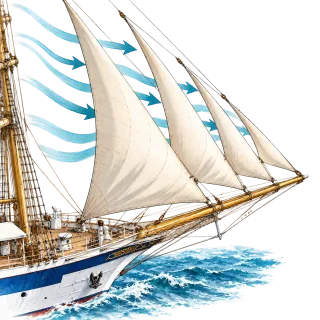
A sail works much like a wing. Wind flows across its curve and draws the ship forward. The crew trim each sail by easing or hauling its lines until the canvas pulls well and the ship settles into a steady motion.
To change direction, the ship tacks, turning her bow through the wind, or wears, turning her stern through it. Either one is worth coming on deck to watch.
The winds behind every itinerary
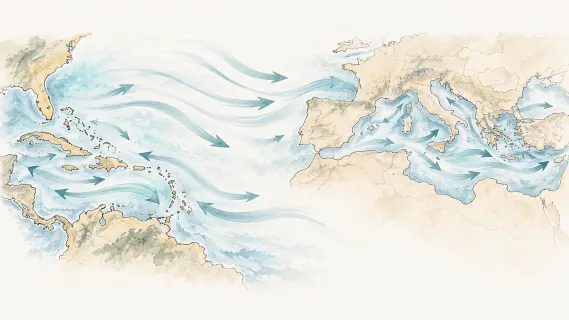
Tall ships have always moved with the seasons. Ours still do, sailing the Caribbean and Central America in winter and the Mediterranean in summer. Each region has its own wind, and each one shapes the voyage.
-
Trade winds, Caribbean: Steady easterlies that blow across the islands through the winter. Long, easy days under sail, and the same winds that have carried ships west across the Atlantic for centuries.
-
Meltemi, Greek Isles and the Turkish coast: A dry northerly that sweeps the Aegean in summer. Brisk at times, with clear skies and some of the best sailing of the season.
-
Mistral, southern France and Corsica: A cool northwesterly that funnels down the Rhône valley to the sea, clearing the skies and giving the ships a strong breeze to work with.
-
Sirocco, Malta, Sicily and southern Italy: A warm southerly that carries north from Africa across the central Mediterranean.